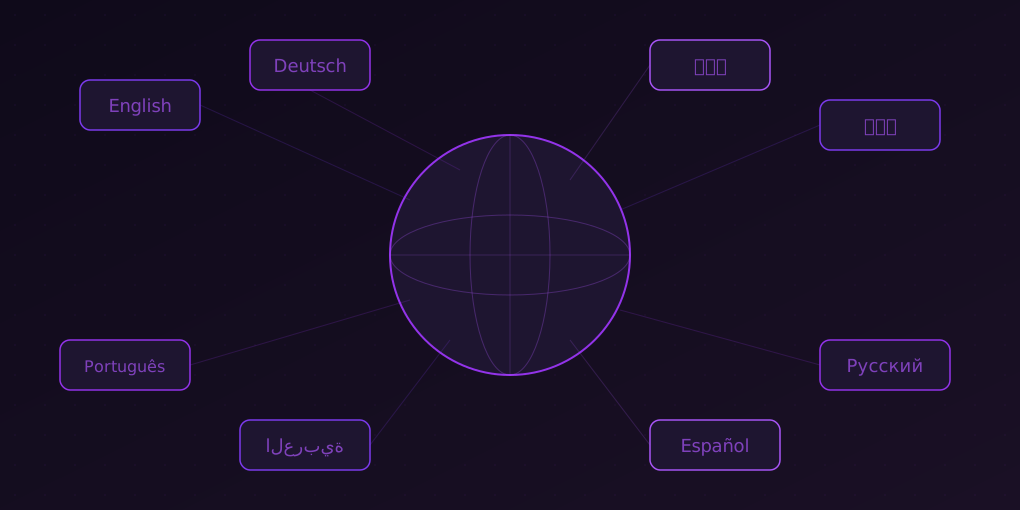
Why Multilingual Summarization Changes Everything for Global Teams
Global teams waste hours on language barriers. Multilingual AI summarization lets every team member read, understand, and act on content in any language — in minutes, not days.
A design lead in Berlin finds a groundbreaking UX research paper — written in Korean. A product manager in Sao Paulo needs to brief the CEO on a Japanese competitor analysis. A developer in Lagos is trying to make sense of a French open-source documentation page that has no English translation. In each case, the information exists. The problem is not access. The problem is language.
Global teams are not a future trend. They are the present reality. According to a 2025 report from Gartner, 72% of enterprise software teams now span three or more countries. Startups routinely hire across continents from day one. Remote work has made geography optional, but it has not made language optional. And that gap — between the global nature of modern teams and the stubbornly monolingual nature of most knowledge tools — is costing organizations far more than they realize.
This article explores why multilingual summarization is not just a nice-to-have feature for global teams, but a fundamental shift in how distributed organizations consume, share, and act on information. We will look at the real-world pain points, walk through practical workflows, and show how tools like 5MinRead are making language barriers in knowledge work a thing of the past.
1. The Hidden Tax of Language Barriers
The Cost Nobody Measures
Most organizations track obvious costs: salaries, software licenses, cloud infrastructure. Almost none track the cost of language friction. But it is enormous.
Consider what happens when a team member encounters important content in an unfamiliar language:
- Time cost: A native English speaker reading a German technical paper might spend 30-45 minutes with a translation tool, compared to 10 minutes for a native German speaker. Multiply this by dozens of articles per week across a team of 20, and you are looking at hundreds of lost hours per quarter.
- Comprehension cost: Machine translation preserves words but often loses meaning. Technical jargon, idiomatic expressions, and cultural context get mangled. The reader comes away with a rough understanding at best, a wrong understanding at worst.
- Avoidance cost: The most insidious cost is the content that never gets read at all. When faced with a foreign-language source, most knowledge workers simply skip it. That Korean market report? Filed away. That French patent filing? Ignored. The information asymmetry compounds over time.
Why Translation Alone Is Not Enough
Traditional translation tools solve a different problem. They answer the question: “What do these words mean in my language?” But that is rarely what a busy professional needs. What they actually need is: “What are the key insights from this document, and how do they affect my work?”
A 5,000-word German regulatory document, translated word-for-word into English, is still a 5,000-word document that demands 20 minutes of reading and significant mental effort to parse. What the reader actually needs is a 300-word summary of the three regulatory changes that affect their product, delivered in clear English.
This is the difference between translation and multilingual summarization. Translation moves words between languages. Summarization extracts meaning and delivers it in your language. The distinction matters enormously for teams operating at speed.
2. What Multilingual Summarization Actually Means
Beyond Word-for-Word
Modern AI does not translate content and then summarize it. It does something fundamentally more powerful: it comprehends the source material in its original language and generates a new summary in the target language. These are two distinct cognitive operations happening in a single pass.
Here is what this looks like in practice:
- The AI reads a 4,000-word article in Japanese about semiconductor supply chain disruptions
- It identifies the core arguments, supporting data, and key conclusions
- It generates a structured 400-word summary in Portuguese, using natural Portuguese phrasing and terminology appropriate for the subject matter
The output is not a translated summary — it is a natively written summary that happens to be based on foreign-language source material. The difference in readability and usefulness is dramatic.
How 5MinRead Implements This
5MinRead supports 15 languages across the entire summarization pipeline: English, Russian, German, Spanish, French, Italian, Portuguese, Japanese, Chinese, Korean, Arabic, Hindi, Turkish, Vietnamese, and Polish. This is not just interface translation — the AI generates summaries, highlights, and research outputs in all 15 languages.
Here is how it works:
- Input: Any web page, PDF, or YouTube video in any language the AI models understand (which covers virtually every major world language)
- Processing: The AI reads the full content, extracts meaning, and identifies key information
- Output: A structured summary in your preferred language, using natural phrasing and appropriate terminology
- Presets: All 21 built-in summarization presets (Standard, Quick, Academic, ELI5, and more) include i18n support across all 15 languages
The user sets their preferred language once in the extension settings. From that point forward, every summarization — regardless of the source language — arrives in their chosen language.
3. Five Scenarios Where This Changes the Game
Scenario 1: International News Monitoring
The problem: A communications team at a multinational needs to monitor news coverage across 8 countries. Each morning, a junior analyst spends 3 hours scanning foreign-language news sites, running articles through Google Translate, and compiling a briefing document.
With multilingual summarization: Each team member installs 5MinRead, sets their language to English, and browses foreign news sites directly. One click produces a clear English summary of any article. The morning briefing that took 3 hours now takes 45 minutes, and the quality of the summaries is higher because the AI captures nuance that machine translation misses.
Real impact: The analyst can now cover 3x more sources in less time, catching stories that were previously missed because nobody had time to translate them.
Scenario 2: Cross-Border Academic Research
The problem: A PhD student in Canada is researching urban planning policy. The most relevant recent studies are published in German, Japanese, and Portuguese journals. Each paper takes 2-3 hours to read through translation tools, and the student can only manage 2-3 foreign-language papers per week.
With multilingual summarization: The student opens each paper (or its PDF) in the browser and uses 5MinRead’s Academic preset to generate a structured English summary. In 60 seconds, they have the methodology, key findings, and conclusions in clear academic English. They can now screen 15-20 foreign-language papers per week, diving deep only into the most relevant ones.
Real impact: The literature review that would have taken 3 months takes 3 weeks. The thesis is stronger because it incorporates research that would otherwise have been inaccessible.
Scenario 3: Multilingual Team Communication
The problem: A 30-person engineering team spans Tokyo, Berlin, and Sao Paulo. Team leads share important articles in Slack, but most are in the sharer’s native language. The Tokyo lead shares a brilliant Japanese blog post about microservices architecture. The Berlin engineers ignore it because they cannot read Japanese.
With multilingual summarization: The Tokyo lead shares the article link along with a 5MinRead summary generated in English (the team’s lingua franca). Or better yet, each engineer has 5MinRead configured in their own language and can summarize the Japanese article directly. The Berlin engineers get it in German. The Sao Paulo team gets it in Portuguese.
Real impact: Knowledge actually flows across language boundaries. The team’s collective intelligence increases because good ideas are no longer trapped behind language walls.
Scenario 4: Competitive Intelligence
The problem: A SaaS company’s strategy team needs to track 12 competitors across 6 countries. Competitor websites, press releases, and blog posts are in the local language. The team relies on quarterly reports from a consulting firm that cost $15,000 each and are always slightly out of date.
With multilingual summarization: Each strategist monitors competitor content directly, using 5MinRead to summarize press releases, blog posts, and product announcements in real time. A Korean competitor’s product launch blog post becomes a crisp English summary in 30 seconds.
Real impact: Competitive intelligence becomes continuous instead of quarterly. The team spots market moves weeks before they would have appeared in a consulting report. The $60,000 annual consulting spend is redirected to higher-value work.
Scenario 5: Regulatory Compliance
The problem: A fintech operating in the EU needs to track regulatory changes across 6 jurisdictions. Regulations are published in the local language — French in France, German in Germany, Italian in Italy. The compliance team has two bilingual lawyers who are constantly overwhelmed.
With multilingual summarization: When new regulations are published, a compliance analyst opens the document and generates a summary using 5MinRead’s Detailed preset. The 80-page French regulation becomes a structured 500-word English summary highlighting the key changes and compliance deadlines. The bilingual lawyers review only the most impactful changes instead of reading everything.
Real impact: Compliance review time drops by 60%. The team catches regulatory changes faster and has more time for implementation planning.
4. The Technical Foundation: Why This Works Now
Large Language Models Are Inherently Multilingual
The reason multilingual summarization works so well in 2026 is that modern large language models are trained on text in dozens of languages simultaneously. They do not treat languages as separate systems. Instead, they develop an internal representation of meaning that transcends language boundaries.
This means the AI can:
- Read a document in one language and genuinely understand its content
- Identify which information is most important based on the semantic meaning, not just keyword frequency
- Generate a new text in a different language that faithfully represents the original meaning
- Adapt terminology and phrasing to be natural in the output language
This is a qualitative leap beyond traditional machine translation, which operates at the surface level of words and grammar. The AI operates at the level of meaning.
Why Summarization Plus Translation Is Better Than Either Alone
Consider three approaches to handling a foreign-language article:
- Translation only: You get the full text in your language. It is long, often awkward, and requires the same reading time as the original.
- Summarization only (in source language): You get a short version, but it is still in a language you cannot read fluently.
- Multilingual summarization: You get a short, clear version in your language. This is the only approach that solves both the language barrier and the information overload problem simultaneously.
5MinRead combines both capabilities in a single operation. One click, and you go from a 4,000-word article in any language to a focused summary in your language.
5. Building Multilingual Workflows with 5MinRead
Setting Up Your Language
The setup is straightforward:
- Install the 5MinRead browser extension
- Open the extension settings
- Select your preferred language from the 15 available options
- Every summary from this point forward will be generated in your chosen language
The extension interface itself is also fully localized in all 15 languages, so the entire experience — from buttons and menus to error messages and notifications — is in your language.
Choosing the Right Preset for Your Use Case
5MinRead offers 21 built-in presets, each optimized for a different type of content and output format. All presets work across all 15 languages. Here are the most relevant ones for global teams:
- Standard: A balanced summary covering the main points. Good for articles, blog posts, and general content.
- Quick (TL;DR + So What?): A rapid summary with actionable takeaway. Perfect for busy executives scanning multiple sources.
- Academic: Structured summary with methodology, findings, and conclusions. Ideal for research papers.
- Detailed: Comprehensive summary that preserves more nuance. Best for complex documents like regulations or technical specifications.
- Pros & Cons: Balanced analysis of arguments for and against. Useful for competitive analysis and decision-making.
- Meeting Minutes: Extracts action items, decisions, and key points. Perfect for summarizing recorded meetings or transcripts.
- Investment Brief: Financial-focused summary with market implications. Great for cross-border financial analysis.
Team Workflows
Here are three proven workflows for global teams:
Workflow 1: The Shared Summary Channel
Create a dedicated Slack or Teams channel for shared summaries. When any team member finds valuable content in their language, they summarize it with 5MinRead and share the summary in the team’s common language. This creates a continuously updated knowledge base that transcends language barriers.
Workflow 2: The Morning Intelligence Scan
Each team member is assigned 3-5 foreign-language sources to monitor (competitor blogs, industry publications, regulatory sites). Each morning, they scan their assigned sources and use 5MinRead to generate summaries of anything noteworthy. The summaries are compiled into a daily briefing document that the entire team can read in 5 minutes.
Workflow 3: The Research Sprint
When tackling a new market, technology, or competitive question, assign team members to search for sources in different languages. The Japanese-reading team member searches Japanese sources, the German-reader covers German sources, and so on. Everyone summarizes their findings using 5MinRead’s Research Mode, and the results are synthesized into a comprehensive multilingual research brief.
6. Best Practices for Multilingual Summarization
Tip 1: Match the Preset to the Content Type
A Quick summary works well for news articles but loses too much detail for regulatory documents. An Academic preset is perfect for research papers but overly structured for a casual blog post. Spending 5 seconds choosing the right preset saves minutes of confusion later.
Tip 2: Use the Summarization Length Settings Strategically
5MinRead offers multiple length options (Small, Medium, Full, Maximum). For initial screening of foreign-language content, start with Small — you just need to decide whether the source is worth deeper investigation. Switch to Full or Maximum when you need comprehensive coverage of an important document.
Tip 3: Cross-Reference When Stakes Are High
For high-stakes content (legal documents, contracts, regulatory filings), use the summary as a screening and orientation tool, not as a replacement for professional translation. The summary tells you what the document is about and whether it matters. If it does, invest in proper legal review.
Tip 4: Leverage Auto-Highlight for Quick Scanning
5MinRead’s auto-highlight feature identifies and highlights the most important passages in an article. When combined with multilingual summarization, this lets you quickly scan a foreign-language article’s key points before or after reading the full summary.
Tip 5: Build a Multilingual Research Library
Use 5MinRead’s Research Mode to collect and organize sources across languages. You can add sources in Japanese, German, and Portuguese to the same research project, summarize each in your language, and then use the synthesis feature to generate a unified analysis that draws from all sources.
7. The Competitive Advantage of Linguistic Reach
Information Asymmetry Is a Strategic Asset
Most teams operate in an information bubble defined by the languages their members speak. An English-speaking team reads English sources. A Japanese-speaking team reads Japanese sources. Each team is working with an incomplete picture of the world.
The team that breaks out of this bubble gains a significant competitive advantage:
- They spot trends earlier because they are monitoring sources that competitors cannot read
- They make better decisions because they have access to a wider range of perspectives and data
- They innovate faster because they can draw on ideas from research published in any language
- They avoid surprises because they catch regulatory changes, competitive moves, and market shifts that monolingual teams miss
Multilingual summarization is the technology that makes this linguistic reach practical. Without it, monitoring foreign-language sources is theoretically possible but practically infeasible. With it, any team member can access and understand content in any language with a single click.
The Mathematics of Knowledge Access
Consider the numbers. English represents about 60% of web content. By adding just four more languages — Chinese, Spanish, Japanese, and German — you cover roughly 85% of all online content. With 5MinRead’s 15 supported languages, your team can access and understand content representing over 95% of the world’s online knowledge.
That extra 35% of non-English content is not randomly distributed. It includes:
- Regional market data and consumer research published only in local languages
- Academic papers in non-English journals (especially in fields like engineering, medicine, and social sciences)
- Government reports and regulatory documents
- Local news coverage and industry analysis
- Patent filings and technical documentation
Each of these represents information that your English-only competitors cannot easily access. Multilingual summarization turns this information from theoretically available to practically useful.
8. Looking Ahead: The Future of Multilingual Knowledge Work
The technology is improving rapidly. Today’s multilingual summarization is already highly capable, but several trends will make it even more powerful:
- Better support for specialized terminology: AI models are getting better at handling domain-specific vocabulary across languages, especially in legal, medical, and technical fields
- Longer context windows: As AI models can process longer documents, they will be able to summarize entire books, regulatory frameworks, and multi-part reports in a single pass
- Real-time collaboration features: Future tools will enable teams to collaboratively annotate and discuss summaries across language boundaries
- Voice and video integration: Summarization of spoken content in any language will become as seamless as text summarization is today
Organizations that build multilingual knowledge workflows now will be well-positioned to take advantage of these advances. The teams that wait will find themselves increasingly disadvantaged as their competitors gain access to a broader, deeper, and more diverse pool of global information.
Conclusion: Language Should Not Be a Barrier to Knowledge
The promise of the internet was universal access to information. For decades, language barriers have made that promise only partially true. If you speak English, you have access to a vast library of knowledge. If you do not, or if the specific knowledge you need happens to be published in a language you do not speak, you are out of luck.
Multilingual AI summarization changes this equation fundamentally. It does not just translate words — it extracts meaning from content in any language and delivers it in yours. For global teams, this is not an incremental improvement. It is a step change in how knowledge flows across language boundaries.
5MinRead puts this capability in your browser, one click away from any article, PDF, or video on the web. With 15 supported languages, 21 summarization presets, and a research mode designed for cross-language investigation, it is built from the ground up for the reality of multilingual knowledge work.
Your team’s knowledge should not be limited by the languages your members happen to speak. Try 5MinRead and start breaking down the language barriers that have been silently limiting your team’s potential.