AI Summaries for Investors and Analysts: Earnings Reports, 10-Ks, and Analyst Notes in Minutes
How portfolio managers, equity analysts, and individual investors can use AI summarization to process earnings reports, SEC filings, and sell-side notes faster — without losing the details that matter.
If your job involves moving money based on what companies report, you have a reading problem. Every quarter, the companies you follow drop earnings releases, 10-Q filings, conference call transcripts, and management presentations. The sell-side adds 30-page initiation reports and 8-page maintenance notes. Industry analysts publish white papers. Trade publications cover the same events from different angles. You cannot read all of it. But you cannot afford to miss the parts that change your thesis.
This article is about how investors, equity analysts, and finance professionals are using AI summarization to expand the surface area of what they can process, without giving up the precision that the job actually requires.
The Reading Volume Problem in Finance
A mid-cap equity analyst covering 20 names has, on average:
- 80 earnings releases per year (4 per company)
- 80 conference call transcripts
- 80 10-Q and 10-K filings
- 150–400 sell-side notes from the analysts they monitor
- Industry research, peer commentary, conference notes
- News flow on every name, every day
The earnings calls alone, transcribed, are roughly 1.5 million words per year. The filings add another 5 million. No human reads it all. The honest version of the job is: you read closely on the names you have strong views on, you skim everywhere else, and you hope you do not miss something that matters.
Summarization shifts that math. If you can compress an earnings release into a 200-word summary that captures the actual changes — guidance, segment mix, margin drivers, capex — you can stay current on a much wider universe without losing depth on your core names.
What “Good” Looks Like for Finance Summaries
Generic summaries are dangerous here. “The company reported strong Q3 results” is worse than not reading the release at all, because it conveys false confidence. Finance summaries need to do three things that general summaries usually do not:
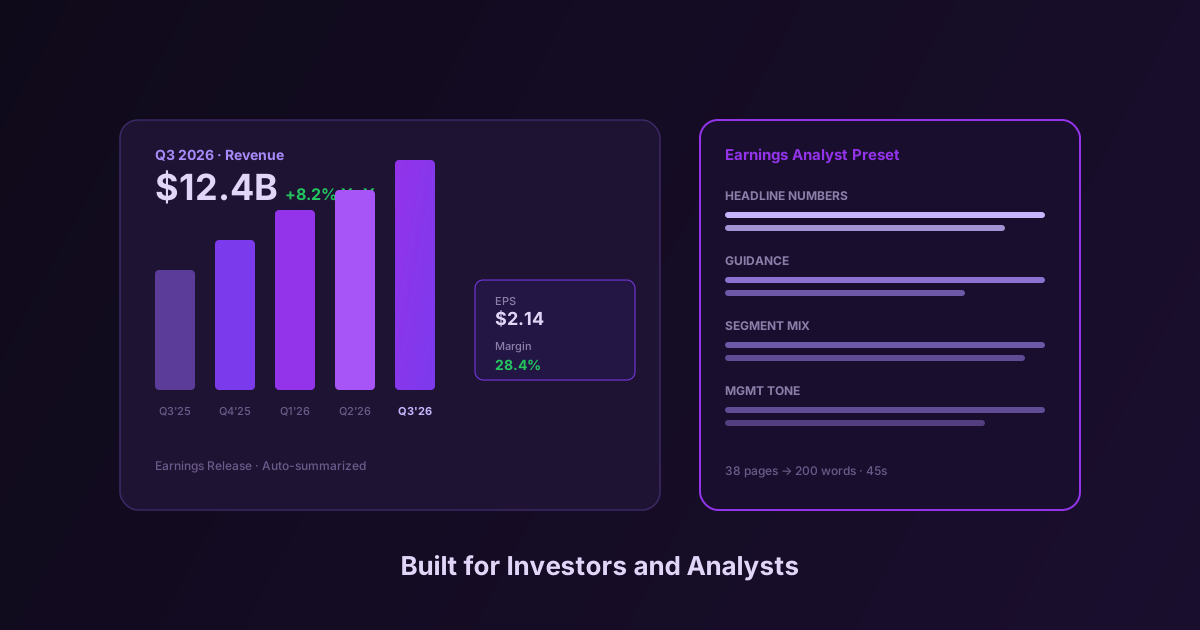
Preserve the numbers. Revenue, EPS, guidance bands, margin levels, segment growth rates — these are the substance. A summary that paraphrases “revenue beat expectations” instead of “revenue of $12.4B vs $12.1B consensus, up 8% YoY” is useless.
Surface the deltas. What changed since last quarter? What changed in the guidance? What was added or removed from the risk factors? A summary that just describes the latest report misses the comparison that matters.
Flag the qualifications. Management language is dense with qualifications. “We continue to see strong demand” and “we are seeing some moderation in select verticals” are both true statements about the same business. A summary that drops the qualifications gives you a false reading.
Building a Finance-Specific Preset
The default summary presets in 5MinRead are general-purpose. For finance work, you want a custom preset. Here is a starting point you can adapt.
Preset: Earnings Release Analyst
System prompt:
You are summarizing an earnings release for a professional equity analyst. Structure your output as follows:
Headline numbers (with YoY comparison and consensus)
- Revenue
- EPS
- Operating margin
- Free cash flow
Guidance changes
- Compare current quarter / full year guidance to prior. Note direction (raised/lowered/maintained) and magnitude.
Segment performance
- For each reported segment: revenue growth, margin direction, one-line driver commentary.
Notable callouts
- Acquisitions, divestitures, buybacks, dividends, restructurings, executive changes.
Management tone
- Quote 2-3 sentences from the prepared remarks that signal confidence direction. Preserve qualifications verbatim.
Preserve all numerical values exactly. Do not round or paraphrase numbers. If a metric is not disclosed, write “Not disclosed” — do not estimate.
You will iterate on this preset for weeks. Each company has a slightly different reporting convention, and the preset that works for a software company will not be ideal for a bank or a manufacturer. Most analysts end up with three or four specialized presets — one for software, one for financials, one for industrials, etc.
Workflows That Actually Save Time
Earnings Season Triage
During earnings season, you have 15 names reporting in a single week. The realistic workflow:
- Set up a research project for the quarter
- As each release drops, drop the release URL and the press release into the project — both summarize automatically with your custom preset
- Scan the summaries to flag which names had real news vs maintenance updates
- For the names with real news, open the transcript and 10-Q and summarize those into the same project
- Use the project’s synthesis function to extract cross-portfolio patterns — e.g., “How many of your software names commented on macro? In what direction?”
This is the difference between starting Friday morning with 15 unread documents and starting Friday morning with three to read closely and twelve already mentally filed.
Sell-Side Note Compression
A 32-page initiation report from a sell-side desk has maybe 4 pages of actual new information. The rest is industry primer, company background you already know, and tables that are useful for reference but not insight. Summarize the note with a “What is new?” preset that explicitly tells the model to skip background and focus on the analyst’s actual differentiated view. You will get the substance in two minutes, and you keep the original PDF for the tables.
Conference Call Q&A Mining
The prepared remarks are scripted. The Q&A is where information leaks. Most analysts skim prepared remarks and read Q&A closely. The right preset:
Summarize this earnings call transcript focusing only on the Q&A section. For each analyst question, write one line: who asked, what they asked, and what management’s answer revealed (substance, dodge, or commitment). Quote management verbatim when they make specific forward statements.
You get a structured Q&A breakdown that surfaces commitments and dodges in seconds.
10-K Risk Factor Diffing
Risk factors in 10-Ks change subtly year over year. A new risk factor is a signal. A removed risk factor is a signal. A reworded one might be a signal. Summarize both the current year and prior year risk factors with the same preset focused on listing risks one per line, then compare the two lists. Most years there are 2-3 changes worth knowing about. Without summarization, finding them in 80 pages of legal prose is a half-day task.
What to Watch For
A few honest cautions for finance use cases.
Do not trust numbers in summaries without verification. Models hallucinate digits. They will swap a 7 for a 1, or misplace a decimal. Auto-highlight helps here — the highlight points back to the actual sentence in the original, so you can verify before quoting.
Custom presets need iteration. Your first version of an earnings preset will produce something that looks right and is wrong in subtle ways. Run it on three or four releases and compare to your own read. Refine the prompt where it missed.
Guidance language is adversarial. Companies word guidance carefully. A summary that smooths over the wording can lose the lawyer’s-eye distinction that matters. For high-stakes situations, the summary is a triage tool, not a substitute.
Compliance. Check your firm’s policy on running internal documents and unreleased information through external AI services. Public filings and public sell-side notes are generally fine. Internal investment memos and unfiled drafts are not.
The Compounding Effect
The investors and analysts who get the most value from this are not the ones who use AI to do less work. They use AI to expand their coverage. The two hours you save on the names you already cover well, you spend reading two extra names you previously could not get to. Over a quarter, that adds up to genuinely broader understanding — and broader understanding is where edge usually comes from in this work.