I Read 100 Articles a Week for 30 Days Using AI. Here Is What Happened.
A month-long experiment in heavy AI-assisted reading — what worked, what failed, and the surprising things that changed about how I think when summaries replace skimming.
The experiment had a simple rule: for 30 days, I would attempt to genuinely engage with 100 articles per week. Not skim, not bookmark-and-forget — engage. Read the summary, scan the highlights, save the ones that matter, write down what I learned. Across four weeks, that is 400 articles. To put this in scale, the average professional knowledge worker reads somewhere around 30-40 articles a week, of which maybe 8-10 are read with any real attention.
I did this because I was curious about a specific question: does heavy AI summarization make you read more, or does it just make you a faster skimmer? Is there a qualitative shift, or is it just speed? Below is what I noticed. Some of it is what I expected. Some of it surprised me.
The Setup
I used 5MinRead with a few custom presets, a daily reading list of RSS feeds and newsletter subscriptions, and a simple notebook for “things I want to remember”. Reading happened in three time blocks: morning (45 min), midday (30 min), evening (45 min). The rule was that every article I opened had to be processed — summarized, scanned, and either filed as relevant or discarded.
I tracked four things daily:
- Number of articles processed
- Number filed as relevant (worth referencing later)
- One sentence I wrote about each “relevant” article
- Energy level at end of session (1-10)
This was not a scientific study. I am one person, with one set of interests. But I think the patterns are useful to anyone considering whether heavy AI-assisted reading is something they want to try.
Week One: The Velocity Trap
The first week, I read 132 articles. I felt like a genius. I was working through my saved RSS feed at a pace I had not managed in years. I felt like I was finally going to be “caught up” on the industries I follow.
By Friday I noticed something concerning: I could not actually remember anything specific from Wednesday’s reading. I could tell you that Wednesday was a “big AI news day” — there was something about a new model release, something about chip supply, something about a regulation in Europe. But I could not tell you the details that would let me have an intelligent conversation about any of it.
This is the velocity trap. When you process information fast enough, your brain treats it as ambient noise rather than information. You feel productive. You are actually less informed than someone who read three articles closely.
Week Two: Slowing Down to Speed Up
Week two I cut the target to 80 articles and changed the workflow. Every article that scored “relevant” got a second pass — I read the auto-highlights closely, not just the summary, and wrote a one-sentence note that had to be specific. Not “Anthropic released something” but “Anthropic released Claude 4.7 with a 40% improvement on coding benchmarks but no change to context window.”
Article volume dropped to 78 that week. But the qualitative feel shifted dramatically. I could close my laptop on Wednesday and recall, on Sunday, specific claims from articles I had read on Monday. Not all of them. But enough that conversations about current events felt grounded again.
The insight: summarization is the first half of comprehension. Writing a specific sentence about what you learned is the second half. If you skip the writing, you might as well have skimmed.
Week Three: The Boring Discovery
By week three the workflow felt natural. I was processing around 90 articles a week, retaining the substance of maybe 50, and writing meaningful notes on roughly 25. The big insight of week three was boring: most articles are not worth reading.
I had always suspected this. Heavy summarization makes it undeniable. When the summary is good and the highlights tell you the substance, you can tell, in 30 seconds, whether an article has anything new to say. Most do not. They restate consensus. They repeat last week’s news with one new quote. They expand a tweet into a 1,200-word article without adding information.
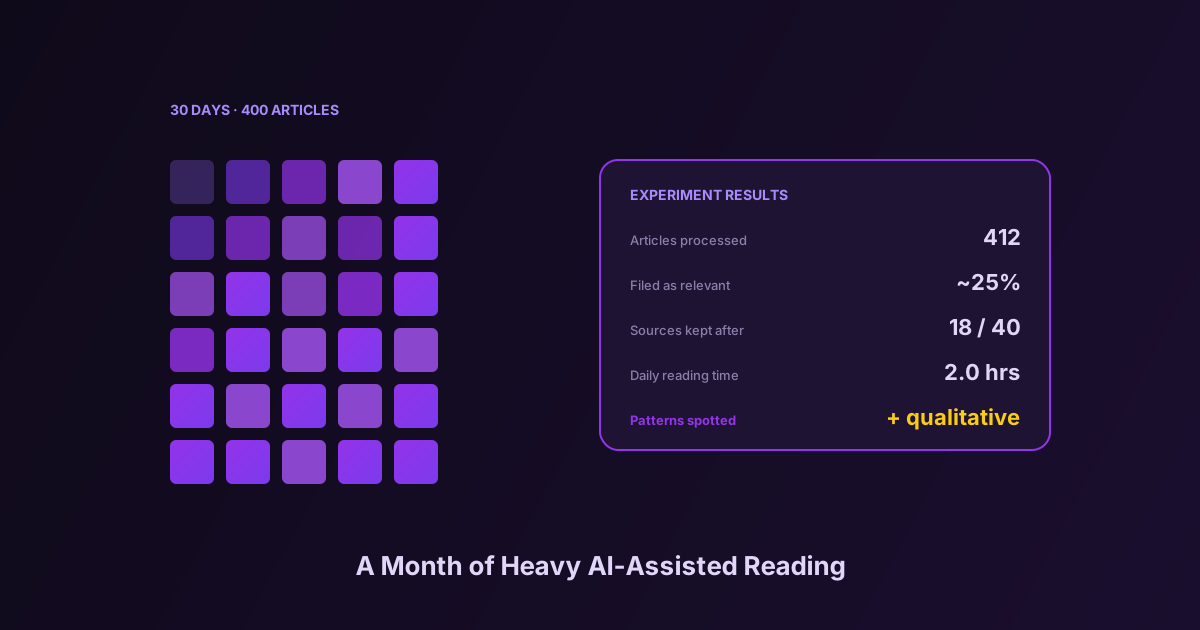
The estimate from my own notes: maybe 25% of articles in my RSS feeds had any new information for me. The rest were either reformulations of things I already knew, or shallow takes that did not survive a structured summary.
This was useful in an uncomfortable way. It meant my pre-experiment reading habits had been mostly performative — opening 30 tabs per day to feel like I was keeping up, then closing them having absorbed almost nothing. The honest version of “staying informed” is much smaller than the version most knowledge workers perform.
Week Four: The Compounding Effect
Week four was the most interesting because I noticed effects that were not about reading at all.
I started recognizing patterns across articles that I would not have noticed without the volume. When five different writers, in five different industries, used the same phrase or referenced the same idea in a single week, I noticed. When two articles made directly contradictory claims about the same data, I noticed. When a piece of news got covered five times and each version emphasized something different, I noticed.
This is the compounding effect of breadth. You cannot get cross-source insight by reading one source closely. You get it by sampling many sources and letting your brain do pattern recognition. AI summarization makes that volume tractable without making the individual reads useless.
Specifically, I caught two ideas in week four that became productive for me — one was a product hypothesis I would not have arrived at without seeing several adjacent articles in the same week, and one was a contrarian read on a market trend that emerged from contradictions I would not have noticed without comparing multiple sources side by side.
What I Was Wrong About
I went into the experiment thinking the win would be quantitative — reading more, knowing more. The win was qualitative — knowing what to read more carefully, and knowing what to ignore. AI summarization did not make me a faster reader. It made me a more selective one.
I also thought it would feel like cheating. It did not. The closest analogy is using a search engine. Nobody feels guilty about using Google instead of a library card catalog. The friction is gone, and what is left is your judgment about what is worth your attention. Summarization is similar — the friction of skimming is gone, and your judgment about which articles to read closely is what matters.
What I Was Right About
The thing I was right about: this only works if you have a workflow that turns reading into something. For me that was the daily notes. For you it might be sharing summaries with a team, building a knowledge base, prepping for meetings, writing your own pieces. If reading is the input but nothing comes out the other end, AI summarization just makes you a faster consumer of disposable content.
Recommendations If You Try This
If you want to try a heavy-reading month yourself, three things from my experience:
Set a quota and stick to it. Without a target, you will read less, not more. Pick a number that feels uncomfortable.
Write one sentence per article you flag as relevant. This is the keystone. Skip this and you might as well have skimmed.
Cut the source list ruthlessly. Week one I tried to keep up with 40 RSS feeds. By week four I was down to 18 — the ones that produced new information often enough to be worth checking. The other 22 are still bookmarked, but I do not read them anymore.
The cumulative effect of a month of this is hard to describe without sounding grandiose. I will say: I came out of it with a clearer model of three industries I follow than I had at the start, and with two ideas worth following up on that I would not have arrived at by reading half as much.
Whether that is worth the time is up to you. For me it was. The friction of the old way — open 30 tabs, read three closely, close 27 with vague guilt — turned out to be the thing that was wasting my time, not the volume.